Saturday, November 01, 2014

Review - The Dancing Floor

I had this review from W_.  We were both guests at a friend’s place and, Scottish weather being Scottish weather, the haggis hunting that day had been postponed due to the traditional sleet and snow that typifies Spring in the Highlands.  Seeking distraction and entertainment, I wandered to the library hoping to find at least our host’s selection of plainly bound pornography.

W sat by the fire, both were smoking.  Beside him on a small table rested an oversized decanter.  The glass was in his hand.  W was known to bring his own supplies on these trips, having once being forced to spend a weekend snowed in on the moors with only the host’s blended scotch to pass the time.
‘You’ll want the Buchan.’  He advised, gesturing to a bookcase with his foot.  ‘To your left, second shelf, yellow dust jacket.  ‘The Dancing Floor’.  That’s what you want.’
He topped up his glass and, without invitation, began.
‘The Dancing Floor may not be the greatest book ever written, but it’s the greatest adventure story I’ve ever read.
Its construction is superb.  Its author’s audacity breathtaking.  It begins with an admirably short introduction where the writer explains that this is a story he heard from a friend as they both passed the time when taking civilized refuge from an unseasonable climate.  By the end of that first paragraph, one is hooked.
The astonishing thing is that, for a novel of adventure, so very little happens for so very long.  Buchan shows exceptional nerve, and prodigious skill, in maintaining, and building, tension, moving inexorably towards the climax, where a lot happens in a very short period of time.
The premise is intriguing.  The first portion of the book deals with the storyteller’s friendship with a young friend of the family, and how this singular young man is visited by an annually recurring dream.  Surely, the reader thinks, this must be the key to the adventure and not just mystical tosh.
It’s a measure of Buchan’s confidence that the Great War is briefly explained as an wholly unexpected interlude offering adventure and excitement.  One cannot but help admire Buchan’s mastery of understatement here, as both central characters are clearly profoundly affected by their experiences at the front, most markedly in it being confirmed to them, on a grand scale, that when beastly things are in the offing, a British gentleman is justified in grabbing a pistol and the initiative and jolly well sorting things out, no matter where this might take him.
Then the book takes a most unexpected turn, the young man and his strange dream all but vanish from the narrative and we are introduced to a rare and exotic bird, a young and, naturally, beautiful woman who is far braver than any of the male characters.
Her somewhat shocking behaviour in London society is explained away by her growing up abroad and, page by page, we learn more about her background, and the terrible fate that awaits her.  She is determined to make amends for her father’s misdeeds at the family home on a remote Greek island.  The islanders however, think that this can best be achieved by torching said home, and her.
And so the book races towards its conclusion, but not before Buchan pulls off a masterstroke, changing narrative perspective at a crucial point but in such a way as to excite the reader rather than to frustrate.
This is a masterpiece.  Its depiction of London pre and post Great War is superb and Buchan’s depiction of the effect of the conflict on even the stoutest of English hearts is surprisingly compassionate in a tale of high adventure.  He is also gifted in describing the society of the time.
The Dancing Floor is a tale of high adventure, dazzlingly well written.  It is about destiny, self determination, family, friendship, conflict and Bad Blood.  It even manages to combine a dash of mysticism with what some might consider heroics, and what other will recognise as the British gentleman at his best, under pressure, with nothing but his wits and a firearm to save the day.
An astonishing tale of high adventure, astonishingly well written.
Anyway, you should read it.’


I bought my copy of ‘The Dancing Floor’ in the Brazen Head second-hand bookshop in Burnham Market, North Norfolk.  This book is the epitome of why it is simply wrong to own a Kindle.  It’s hardback, it’s got its dust jacket and it’s in fairly good condition.  I’d guess from the ‘reprinted’ history at the front that it’s the June 1938 edition.  Knowing this, it’s not too much of a stretch to think that somebody may have been reading this very book, a thrilling tale of high adventure that includes a passage on the characters adventures during World War One, whilst World War Two raged about them.
What really thrilled me though was when a bus ticket fell out of it as I read on and turned the page.  Then a few pages later, another appeared.  Two tickets, both dated July, one for 9:23, another 10:49.  A return trip…where?  To enlist?  Was some young man reading this book as he bumped to and from an appointment with destiny?


What could make this better?  Only one thing, the tickets have an advert for ‘Turners quality sausages’ and ‘Turners pork pies’ on the reverse!
Those tickets have remained there for what must be decades, and one can only speculate why.  I certainly hope that whoever originally owned the book finished it.
I do know this.  It cost me £4 and it is now the most precious volume in my possession.  The bus tickets still sit inside it, holding place.
You don’t get that with a Kindle.
And as we’re discussing war, the other thing you don’t get with a Kindle is stopping power for a bullet.  It might hold 20,000 books, but the only way a Kindle is every going to feature in a ‘I’d have been a goner if it hadn’t been for my hardback copy of ‘Reform School Girls’ I always carry in my breast pocket’ story is if they bring out the Kindle Kevlar.


Labels: , , , , ,

Friday, June 20, 2014

Postcard from Norfolk - Llama drama


Ever wondered why there were so many churches on the North Norfolk Coast?  Apparently, it’s all to do with an ostentatious display of wealth.  Before expensive divorces and second wives, wealthy businessmen used to spend their money endowing churches.  This achieved the triple whammy of showing everyone how successful you were, ensuring your name is remembered for posterity by having a family pew (remembered for posterior?) or a stained glass window and, of course, getting on the Fast track to heaven.
Wool, it would appear, used to be big business and the North Norfolk coast is ideally suited to tourism, and stupid white things who basically just stand around all day chewing, well, anything.  It was also easier to get your goods to Europe than it was London, thanks to conveniently located sea.
Apparently, people also got rich by piracy, smuggling and subjugating the agricultural workforce, but sheep make for a better subject for a picture in a window.
Today if you want to get rich on North Norfolk you, as far as I can determine, paint your food stall or café that blue/green sedge colour that everyone round here is nuts for, write the word ‘jus’ after every dish on your menu, and charge a fortune.  By the way, ‘locally sourced’ does not, as far as I am aware, mean obtained at the big Tesco in Hunstanton.
But there is still wool here.  Not so much for the sheep, who are pastured in the salt marshes with a view to becoming essentially self-seasoning main courses, but from the llamas.  OK, so there are only half a dozen of them in a field in Wells, but they do make a sight.
Christ alone knows what they make of Wells.  You don’t get much more sea-level than North Norfolk and for an animal used to living at altitude, like athletes in training or chalet maids, it must be something of a surprise to breath the fragrant air of the coast.  Not that they seem to mind.  In fact they don’t seem to mind anything.  Not even people taking pictures of them.
I’m not a huge fan of wildlife photography.  I can barely get friends or family to sit still long enough to take a photograph, and have no patience, so my snapshots of wildlife essentially consists of animals wandering away disinterestedly (although, oddly, one of my photographs was once used in a book about animals, so it just goes to show there’s a market for everything, even pictures of shy pigs).
That said, I enjoy the llamas of Wells-next-the-Sea.  Watching their owner (or a really, really confident looking rustler) walking them along the pavement is a joy to behold.  And it’s lovely to see an elegant creature up close, and downwind.

Labels: , , , , , , , , ,

Postcard from Norfolk - Daffy and Dickie

  
An association is rather a good thing for a public house.  Fame and infamy can equally add character to a pub and, pubs being pubs and human nature being human nature, any pub of a decent age will be more likely to be infamous than famous.  Pubs, you see, even respectable ones with coffee machines and a breakfast menu, are less likely to be the place where a National Treasure hung her bonnet when writing the sort of fiction that is adapted for Sunday night viewing, and more likely to be the place where a laudanum soaked poet wrote his last before drinking himself into an early grave.  Alternatively, they were frequented by a bloke with the charming name of ‘Mad’, ‘Chopper’, or ‘The Lathe’, once to be avoided and now on a Gangland Walks trail.  Many pubs have Blue Plaques, more still have stained carpets.
Indeed, companies exist that can create character in a pub for you.  They scavenge skips (or to give them their full title rural action houses) and can transform a former car showroom into Ye Olde Something Or Other with the addition of only a few antique agricultural implements and a pine-effect condom dispenser.
However, it takes more than a few antique cigerette or Fry’s chocolate machines converted to dispense vape-sticks and pistachios to give a pub atmosphere, especially since the smoking ban came in.  What a pub really needs to do is a holistic historic makeover, setting up web-sites that will convince you that your local boozer has that most attractive of qualities, a pool table (just kidding, I mean A Past).
I used to drink in a pub that was featured on Crimewatch.  Everyone suspected that the landlord had done his wife in because a) she disappeared and b) the cellar acquired a new concrete floor.  The thing is, he kept a good pint.
Tricky moral decision, but when asked if one wanted a quick one ‘up the murderer’s?’, the answer was usually ‘yes’.  In his defence, I don’t think he served Stella, so he was obviously anti-violence to women.
Many pubs have, of course, been around since pilgrims needed somewhere to stop off for a quick drink before visiting Jerusalem.  Given the state of the Middle East today, that remains a good idea.  The older the pub the ‘richer’ the history, usually featuring, appropriately, claret.  But stabbings, gangland slayings and poetry is the least of it, given the amount of former entertainers, a trade that traditionally like a beer, now being locked up, it’s a wonder the police don’t just visit every pub called ‘The Yew Tree’ and throw a net over the regulars.
Of course, the best a Bristish boozer can boast is a resident highwayman.  Bierkellers are an efficient, mechanised, German pub and, if grainy black and white newsreel footage is to be believed (and why not) most of them were frequented by Hitler.  Not so much a Blue Plaque, more a brown shirt moment.
Britain’s pubs are richly decorated, and not just at chucking out time.  The walls of pubs in Britain are adorned not just with Sky Sport posters but with everything from hunting prints, to tabloid front pages, to wanted posters.  Look closer still and you will see why, in Britain at least, pubs remain haunts of gentlemen; photographs of regulars who may have stepped out, but who remain in spirit.
The Hoste Arms in Norfolk remains one of the best pubs in Burnham Market.  It remains so in rthe face of significant challenges, such as having a spa on site, and being frequented by very wealthy people.  It remains a good pub because the staff are quite, quite lovely and the place is at the same time the last word in excellence and not remotely pretentious.  I have had some great times there and sitting in the October sunshine with a glass of champagne and a springer smelling faintly of beach is one of life’s great joys.
The walls of the bar are adorned with original cartoons by Annie Tempest of her weekly strip (ooh er!) in Country Life magazine, ‘Tottering by Gently’, featuring Lord Tottering (‘Dicky’) and his wife, Daffy.  The strip concerns itself, as far as I can determine, with the upkeep of Tottering Towers, their stately home, red wine, dogs and, bizarrely, social media.  The strip is very ‘Country Life’, a magazine slightly up its own arse, more usually up a fox’s arse, but amusing.
All very lovely and slightly more original than a Space Invaders cabinet converted into a wifi booth or whatever.  A recent addition though are busts of Dicky and Daffy.
It’s always tricky to pull off a likeness of a cartoon character.  The last person to do it successfully was Michael Keaton.  However, one you get over the initial shock, they are actually quite fun.  Daffy is just as you would imagine her, although worryingly close to the red wine.
Dicky is fantastic.  That he does not resemble the cartoon character so well is fortunate, because the bust is an incredible likeness of the late, much missed, Professor Brigadier Richard Holmes.
Possibly the sculptor captures the likeness of the wrong Dicky.  Probably he captured the right one.
And if you were playing pub heritage top trumps, military history beats everything else.  From faded photographs of local lads in kaki, through oil paintings of Spitfires, through to bright photographs of local lads in desert gear, and never forgetting the gentleman in the red jacket, every pub should have a military connection.
Finally, the Hoste has it all.

Labels: , , , , , , , , , , , ,

Thursday, June 19, 2014

Postcard from Norfolk - Guns 'n' Bras at Holt

Ah, Holt.  Unlike some towns, usually the sort of town that has butchers that have offerings still in fur and feathers in their front windows, Holt has never crossed the line from Posh to smug.  This may because it’s ‘Holt’, simply ‘Holt’, and lacks the ‘by-the-Sea’ of nearby villages such as the delightful Cley.  It’s not by-the-Sea and ‘by-the-arable-farm’ does not have the same appeal.  For all that the residents of Holt may wish their town to be regarded as posh, and for all that it is undoubtedly monied, a few things keep it firmly rooted in unpretentious.
The first is the art galleries.  Not a natural choice.  If one is grading on the Cotswolds scale of poshness of village as a result of the simple formula of art galleries per head of population (unlike the rural scale of depravation, which is number of pubs per head of population – a healthy ratio being 1:1, in case you are interested), then Holt is very posh indeed.  Luckily, the art galleries perform a public service of selling stuff that is either too expensive, or whacky, to actually buy.
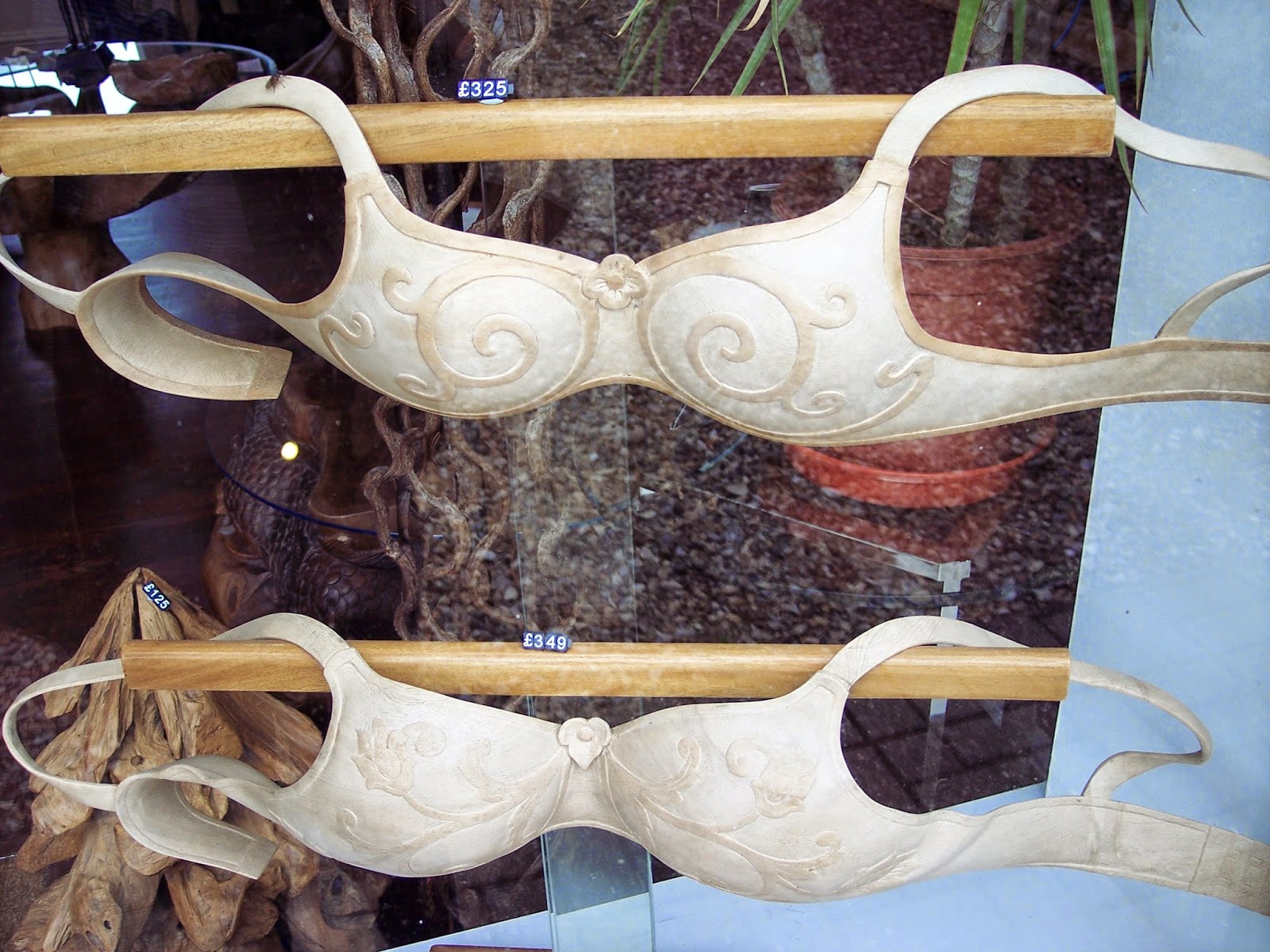
Take for instance the bras carved out of driftwood.  Well, I presume they are carved.  It may be that somebody spends a lot of time beachcombing in order to find naturally occurring double dee cup driftwood.  Never seen any yourself?  Just proves my point, the Coastal Creeper probably got there ahead of you.  Even if you did, you would at most try and get the damn thing out of your dog’s mouth before it charged into the pub with it, or take a picture for the amusement of your more puerile friends.  What you wouldn’t do is fish it out of the surf, dry it, sand it, varnish it, masturbate feverishly over it and then sell it.
So hats off to the galleries of Holt for making visitors smile and move quickly on to the pub.
The other feature of Holt that keeps it thoroughly grounded is the local field sports store.  Now, this used to be in a tiny shop and was crammed with stuff.  It relocated a few years ago to a much larger store that allows them to cram even more stuff into it.  It’s a delight to browse there, if a challenge, because trying to find a camouflage hat in the camouflage section is something of a challenge.  My advice is to buy a duck lure furst, startle the hat and then make a grab for it as it takes flight.  Never seen a flying hat?  Might I suggest a stroll on Brancaster beach in October with insufficiently secured headgear.
Downstairs though, oh, it’s a delight.  That’s where they keep the Guns!  And these are real Guns for men.  These are not the sort of guns that feature in the news, they are not guns for small minded psychopaths, these are guns that are designed to be taken out of the house hours before dawn and held by their owners in darkness, in a hole, in a marsh, waiting for first light.
Because who the fuck needs an alarm clock in Norfolk, it’s rosy red dawn followed by enthusiastic goose calls, then a fusillade, then some likely shouting.
Honk Honk!
Bang!  Bang!  BangBangBang!
Fuck!
Sorry Nigel.  Shit, that looks nasty.
Later that day:
“What did you get darling?”
“Oh, one for the pot, one for A&E”.
That’s why fowl hunters crouch in holes.  It’s not for cover, it’s because some idiot thirty yards away is tracking at zero elevation and doesn’t see you because a) he’s concentrating on a low flying duck and b) you are wearing a camouflage hat, remember?
In short, Holt is lovely, but unglamorous.  Solidly Georgian, with good parking facilities, it remains the sort of Norfolk town that is much more suited to the Defender than the Range Rover Sport.  Leave that to the posh places.

Labels: , , , , , , , ,

Wednesday, June 18, 2014

Postcard from Norfolk - behind the scenes at Wells-Next-The-Sea

Obviously, I’ve always known that Wells-next-the-Sea is a working port.  The clue is all the fishing boats in the harbour, occasionally one putt-puttering along the channel and out to sea.  Then again, most of the time I see the boats I’m looking down on them as they lay beached, thanks to a vertigo-inducing low tide taking them far, far below the harbour wall.
The tide, it would appear, is anti-social, and usually puts in an appearance in the early morning, meaning that fishermen have to get up very early to get their floating boats out there, catch some fish, then back in time for market, breakfast and bed.  No wonder they are all such grumpy bastards when they are interviewed on telly, and it can’t all be the fault of the EU.
More than the boats, it is the crab and lobster pots stacked up in the harbour that reveal the port of Wells to be working.  Downwind, you can tell that a few hours ago, these were immersed in the sea and probably home to a clacky, annoyed and ultimately and unfortunately for the resident, delicious crustacean.
Today though, we walked past the harbour and instead of taking a left at the chandlery and looping up past llamas to the pub, walked on.
Wells has a sailing club!  I mean, of course it does, why wouldn’t it? but they have boats, all varnished and shiny and everything.  And a club house, with a little marquee attached to it which simultaneously announces to the world ‘barbeques are a frequent occurrence here’ and ‘our members like to smoke’.
The racing dinghy’s of the club, uniform in colour, were an incongruous bookend to the fish crates stacked along the harbour, looking for all the world like somebody who was playing Tetris as art.
Yet somehow both were Wells, and epitomised the very picture that everyone has of Wells, the beach huts.  No two exactly alike, but all the same basic design, a shed on stilts, the sort of thing an Englishman exiled to Indonesia or some other flood-prone country would have in his back garden to ensure his mower and trowel stayed dry, yet all different colours.

Past the club house, you come to the real working area of Wells, far (well, twenty steps but metaphorically far) from the whelk stands and rock shops, here are the sheds and warehouses of the fishermen.
I love industry.  Proper industry.  The sort of industry that is all about a proper workshop, home to about seven or eight chaps, who are simply superb at what they do, and smell of swarfega.  You can stick your robot assembly lines right up your arse, if you want something done right, you get a craftsman with a regional accent.
I got the same feeling here.  This was a place of serious toil.  There are some who would say that this sort of thing is unglamorous, and maybe that’s why you have to peek behind the curtain, or at least walk past the pub, to see it.
I wouldn’t agree.  I think there’s a sort of beauty to be found in places like this, where people work hard at difficult jobs, especially when they are not around, when the buildings themselves seem to be resting.  The sheds may be weatherbeaten, but there’s not a stray rope or a scrap of litter to be seen; untidiness and fishing, or industry, do not mix.
Well’s beach huts line up in the sand like sentinels.  Red, white, blue, sometimes red white and blue, they are colourful and characterful.  No less colourful and characterful are the boats bobbing at anchor or, more accurately, by the time I get down the harbour, the boats resting at anchor.  But how good, how reassuring, to know that behind the colour and the character is the substance.

Labels: , , , , , , ,

Tuesday, June 17, 2014

Postcard from Norfolk - Holkham Hall


What do you mean, ‘try something different’?
Here’s what happens when we visit Holkham Hall.  We rock up, we say it used to be better when you could park anywhere, we have a picnic lunch, we walk up to see the Duke, we take a photograph, we visit the gift shop, we decide we don’t need a tweed tea towel that costs thirty quid, we walk back to the car, we admire the deer on the drive out of the estate, we go for a drink at the Hoste.  What’s not to love?
This visit, though, heralded Change.  The kitchen garden is now open to the public.
Thanks to ‘Downton Abbey’, we now know that, prior to the existence of Ocado, feeding a household of a stately home required quite a lot of work.  The extent of the vegetable portion of the meals taken at the Hall, the vegetables in question presumably performing the vital function of soaking up the gravy covering the swan, badger, fox or whether it is that aristocrats eat, was revealed by the size of the gardens.  Picture an allotment the size of a footie pitch.  Of course, because the gardens were tended by members of the working class, it meant that they could also be neat and require a great deal of attention.
The gardens themselves were, actually, something of a delight.  Obviously pretty neglected for many years, they are now being restored, presumably prior to the launch of ‘Holkham Organics’.  They are also impressive.
When the aristocracy build a garden, they don’t start with a trip to B&Q, they start with a team of masons working for about a year on the walls around the place.  Whether this is to deter deer, rabbits or vegetarian poachers is not quite clear.  What is clear is that unless rabbits develop siege-warfare any time soon, they are not going to be getting in at the sprouts.
The next thing that is put in place are greenhouses.  Country folk these days bleat over polytunnels and solar farms, but a quick look over the wall would reveal that the Victorians knew a thing or two about vast glazed areas, and what they knew was that they liked wine, and to make wine you needed vine, so you needed a lot of greenhouse.
Between the icehouse and the greenhouse, no wonder so many great explorers of the age thought visits to the poles or the interiors was such a great idea, they could spend the morning acclimatising, the afternoon playing croquet and the evening having a seventy seven course banquet washed down with home-made plonk and then a bunk up with the maid or, if your tastes ran to rough, the under-gardener.  Shame with all their foresight nobody thought to get inoculate, but maybe a simpler age.
Obviously, having now seen the gardens and, perhaps more importantly, ridden on the little shuttle that takes you back to the Hall (like an oversized golf buggy for eight persons, or like a normal American golf buggy), any future trip will require a return visit there.
Because visiting the kitchen garden, that’s what you do when you visit Holkham Hall.

Labels: , , , , , ,

Monday, June 16, 2014

Postcard from Norfolk - Fish and Chips


One of the holiday party has announced that they are on a mission to have fish and chips every day of the holiday.
Given the enthusiastic rapture that I was in yesterday as a result of the seafood platter at the White Horse (a dish that deserves capitalisation and so will henceforth be known as the Seafood Platter), and the secret ambition I am nurturing not just to have the Seafood Platter every day but, if at all possible, every meal, I am in no position to criticise what I now consider a sound and admirable moral choice.
Because if you are going to choose to have fish and chips every day, this is the place to do it.
Fish and chips on the Norfolk coast is a single meal option with a multitude of options and varieties.  Obviously, you have your sauces, but you also have side dishes.  Well, one side dish, mushy peas.  Simply remembering there are more fish than cod in the sea that taste astonishing when battered for your pleasure makes the possibilities if not limitless, then certainly enough to fill a week.
Me?  I go for cod and chips from French’s, the best fish and chipper in the world.
This, it appears, is hardly a secret.  The queue was, literally, out the door when I arrived.  However, thanks to the experienced team working the friars, it was a moving queue and, because we were all only ten minutes away from golden battered goodness, it was a good humoured one.
It’s not just the tourists who turn up to take away here, it’s the locals too.  What I love about the take away service is that fish and chips is, more than any other food, ideally suited to being a take-away product.
Most importantly, French’s serve their fish and chips in a cardboard container.  No polystyrene here, just good, honest paper-based flatware.  What’s more, they warp them in sheets of paper to keep them warm.  What’s even more, they bag them in paper bags or, more precisely given the amount of fish and chips I was picking up, sacks.  French’s must have a paper bill just below that of a mass-market tabloid.
The benefit of all this is twofold.  Firstly, it keeps everything toasty for the journey back to the caravan, without everything going soggy in the way that using unnatural, godless packaging makes it.  Secondly, it allows the aroma to drift gently up and around the interior of the car.  This is especially wonderful of a wet winter night when, with a warm bag of fish and chips in your lap, the interior of the car slowly becomes a vinegary fug, a different variety of the atmosphere that is normally only found under duvets; warm, welcoming, comforting.
Finally, of course, one has the sauce sachets and condiment packets.  One is treated like a grown up and trusted to sauce and season one’s own whips.  The question is, one sachet of red sauce, or ten?  The supposed answer may be found in the pages of the better guides to etiquette, the actual answer is; as many as one thinks is appropriate.  We don’t judge.


Labels: , , , , , , , ,

Sunday, June 15, 2014

Postcard from Norfolk - Seeseafood

 The Ship, at Brancaster, is one of my favourite pubs.  The staff are friendly, the parking ample, the beer good and the food great.  They make a great flat white coffee, they have conversations with one another about how to make a great flat white coffee, and at the end of the evening the bar staff get up on the bar.  They aren’t doing a dance or anything, they are holding the credit car machine aloft, trying to get a signal.  Maybe in a county as flat as Norfolk, a couple of feet makes all the difference.
Getting a signal was clearly a problem the day when their ‘phone wasn’t being answered, this resulted in taking a punt on getting lunch.  Bad call, no room at the inn.
No problem, onward to the White Horse at Brancaster, which is reliable, spacious, has a great bar menu and more than ample parking.
The White Horse also has something new on the menu.  The seafood platter.
Oh.  My.  God.
This is what bliss tastes like.  This is the desert island meal.  This is the Death Row meal.  This is so very, very good that you want to accost everyone else in the bar and ask them why they are not eating it, while simultaneously resenting anyone else ordering this because they might tell others about it, and reduce the number of seafood platters in future.
It was better than beer.
That’s right.
It should have been no surprise.  The White Horse does exceptional food.  This is a pub that is on the salt marsh and, when the tide is in, is so close to the water you can just about row up to the bar.  This is a pub that has pools full of mussels just outside its back door.  This is a pub, in short, that does seafood.
Presumably they know a chap who does platters and the chef thought, ‘hey ho!  I’ve got an idea!’.
Let’s be quite clear, I was ready to enjoy lunch at the White Horse as only a man who has been disappointed not finding a table and then found an excellent alternative can be.  I was simply not prepared for just how great that alternative was.
The Ship is still one of my favourite pubs in Norfolk, the reasons now extend to that time they were full and we went to the White Horse instead, and discovered the seafood platter.
Now we don’t need to worry about where to go for lunch for the rest of the holiday.  The only conundrum is how many times during the remainder of the holiday it is seemly to go to the White Horse and order the seafood platter.  I’m thinking ‘as often as possible and far more than is decent’.

Labels: , , , , , , , , ,

Saturday, June 14, 2014

Postcard from Norfolk - Caravans

Caravans, it would appear, have come a long way since the holidays of my childhood, when, if I recollect correctly, they were essentially overheated (perfect British holiday weather exists in fading Polaroid’s and childhood memories) Tupperware boxes filled with happy holidaymakers and a miasma of feet and drying beach-towels.
We are holidaying in Norfolk, and we are in a caravan.  This is not a social experiment.  This is real.  It’s also an attempt to ‘try something different”.  Why we have to ‘try something different’, I have no idea, as ‘sticking with the familiar’ is my favourite strategy when on holiday in Norfolk; rise late, walk on beach, lunch, shop at local shops for evening meal, visit the pub, cook dinner, teevee, bed, repeat.
But different it is, and the caravan is certainly that.  A lot of thought has gone into the modern caravan.  For a start, room in the bedrooms has been sacrificed to create more room in the communal areas, including a large kitchen and living area.  Obviously the designers consider that a family going on holiday together will actually want to spend time with each other, which is a charming ideal (it is good to know that there is still a place in the world for wild optimism), or be able to watch the telly in comfort, which is pragmatism.  The seating area is a large el shaped ‘bonkette’, traditionally used by teens for pouty slouches in very much the same boneless way that lemurs drape themselves over tree branches.  As well as a kitchen you can actually cook in, there is a dining table that you can sit at without having to fold away either another piece of furniture, or a teen.  All of this occupies the same space at the front of the caravan, the shared family living space.

The site itself is a mixture of residential and rentals.  You can tell the residential caravans because they are surrounded by tiny gardens enclosed with low fences.  Residential caravans also come with extensions, usually those lock up plastic tool sheds you see that look like a cross between one of those things that go on top of cars for extra luggage, and a portaloo.  Judging by the contents of the open ones, these can house bicycles (sensible) or washing machines (very sensible).

The site itself is a mixture of residential and rentals.  You can tell the residential caravans because they are surrounded by tiny gardens enclosed with low fences.  Residential caravans also come with extensions, usually those lock up plastic tool sheds you see that look like a cross between one of those things that go on top of cars for extra luggage, and a portaloo.  Judging by the contents of the open ones, these can house bicycles (sensible) or washing machines (very sensible).

The site itself is a mixture of residential and rentals.  You can tell the residential caravans because they are surrounded by tiny gardens enclosed with low fences.  Residential caravans also come with extensions, usually those lock up plastic tool sheds you see that look like a cross between one of those things that go on top of cars for extra luggage, and a portaloo.  Judging by the contents of the open ones, these can house bicycles (sensible) or washing machines (very sensible).
In terms of pecking order, residents look down on renters, renters look down on motor-homes and everyone looks down on campers.  Scum.
The caravan has two loos.
That’s right.
Two toilets.  Fuck the iPod, two toilets in a caravan is real design genius.  Two toilets in a caravan is probably the single greatest contribution to family, if not world, peace since the invention of alcohol.
I remember the facilities of my youth.  Even in the long hot summer, where the crispy crinkly grass’s colour had faded like that of an old Polaroid picture first to dull green then to brown, the toilet block had a fringe of lush green grass around it, kept fresh by the eternally damp concrete that was in turn moistened by the Timotei-scented showerings of endless adolescents and the occasional Imperial Leather lathered middle class refugee.
This then, is luxury caravanning.  Luxury because of the space, luxury because there’s a little rack to hang your towels up to dry on the outside of the caravan, luxury because the telly is colour and large (although not as interesting as watching the goings-on of your fellow caravanners through the enormous picture window) and luxury because, most importantly of all, you don’t have to lead a torchlight parade to shared facilities last thing at night, in flip flops.

Labels: , , , , , , , , , ,

Friday, October 19, 2012

Postcard from Norfolk - value for money


North Norfolk Council kindly request that the North Sea refrain from getting all over-excited and move from the left to the right of this picture.

If you live along the coast in North Norfolk, you take sea defences very seriously.  In some cases these are concrete sea walls with gates that shut and have watertight rubber edges, because everyone knows that a washer is going to keep out the fury of a Force Twelve onshore gale.  In other places there are enormous shingle banks and probibitions about what you can do on them, like nbot being able to ride motorcycles, not being able to ride horses and not being able to drive up in the dead of night and fill your trailer full of free aggregate.

There are of course those tasked with putting aggregate back.  Pulling into the car park on Old Hunstanton beach I was pleased to see evidence of my car parking fee – one which I had negotiated rather than having to pay full price no less as this was a short visit – in action.  The chap in the shed was busy with a wheelbarrow full of gravel, a shovel and some pot holes.  The car park here is grass, well, grass and mud.  But increasingly also gravel.  Good to know that if the sea ever does threaten, there will be a bloke with a wheelbarrow at the ready.

Labels: , , , ,

Thursday, October 18, 2012

Postcard from Norfolk - Drink up


'Boat on Cley beach'  The right light, the right angle, a right old pain in the arse getting this shot.
My tip - support the local economy and buy one of the many postcards available with this shot...
but better.

Every year you read about some poor chap who is drowned trying to save his dog after the dog decides to go swimming.  As one of the dogs ran into the surf and suddenly found itself out of its depth, the headline ‘Heroic dog rescuer mourned’, together with a picture of the canine in question sitting on my gave looking properly mournful, flashed through my mind as I started to take off my jacket.  I needn’t have worried as the next wave deposited the dog safely on the shingle, while I wondered if anyone else could hear my heart beating as loudly as I could.


Once my hands had stopped shaking, I set about trying to take the perfect photograph of an upturned boat.  This is apparently easy, as there are many galleries showing variations on this image in just about every visual medium available up to and including modern dance.  My conclusion is that getting a decent photograph is a lot harder than it looks.  You have to wait for the right light, not easy when you have to keep one eye on a dog apparently intent on doing a Reggie Perrin, and you have to find just the right angle, which is, let me tell you, hell on the knees.

After such exertion the place to relax is the marvellous ‘Lobster’ in Sheringham.  Sheringham had just finished celebrating some sort of festival related to World War II, and many of the buildings had bullet holes painted onto them, it was as if the Arab Spring had happened in Norfolk, but with more booze.

The pub itself is an interesting place.  You walk in and there’s a spaniel sitting looking at its owner eating and thinking that maybe, just maybe, this time things will end differently and chips will be involved.  It’s also rather vast, and on different levels, but at the same time cosy.  Best of all, despite the latte and the food, it’s a proper boozer, where men can go in the middle of a long day for a sustaining pint.

I bet it bloody rocks in the evening.

Labels: , , , , , , , ,

Wednesday, October 17, 2012

Postcard from Norfolk - Chips with a view


Pass the salt, and the gull repellant.

French’s fish and chips shop is the best fish and chipper in Norfolk and, if we’re talking pure fish and chipper, probably the best in the world (the fabulous ‘Café Piquante’ in Edinburgh is in a class all by itself, selling as it does the ‘Ladies Special’, chips with cheese and a glass of white wine!), certainly when it comes to taste.  And location, overlooking the Quay at Wells, diners can sit and watch the fishermen arrive and depart and the crabbers pace the edge of the Quay with line and bucket, considering no doubt if they would be better off just making a sandwich out of their bait.


The restaurant area is small, which matters not because the sea wall on the Quay forms al fresco seating for anyone who can’t find a seat in the shop and of course that special extra something that any meal has when consumed in the open air with an aggressive gull beadily eyeing your chips.

As well as the sea wall, seating abounds in North Norfolk.  It’s a beautiful spot with many views, meaning there is no shortage of benches bearing sweet little plaques explaining that such and such loved this view (sometimes of a lovely natural spot, on one occasion in the Buttlands in Wells, towards The Crown, bet he liked the view from the bar out to the bench even more but I guess it’s harder to have a small plaque erected in your memory in a pub, in all my years boozing I’ve only seen one).  Normally, if you notice such a memorial bench at all, you have a read, give a small sigh and move on.

Rather unusual to see not one but two benches bearing bouquets.  If a public bench is adorned at all, it is usually with a scarf or mitten that has been abandoned, but flowers are something new.  And touching.

Labels: , , , , ,

Tuesday, October 16, 2012

Postcard from Norfolk - Hut! Hut!! Hut!!!

Wells-Next-The-Sea, home of the £60,000 beach hut.  That’s right, a beach hut which comes without running water, mains gas or electricity or any guarantee of good weather, will set you back almost as much as a flat.


There are some wonderful examples of the art and I think that most owners are now developing along the lines of ‘the bigger the better’ and ‘the better to ignore any neighbours’.  It also gives an excellent opportunity to give your hut an amusing name, something nautical themes, like ‘the rum shack’, ‘the sodomy shed’ or ‘lashings’.


There are posh huts, there are sheds on stilts and then there are, well, the forgotten huts, victims of the last onshore wind where the beach has eventually crept up the stilts and stairs.  Ideal, of course, for anyone with mobility issues as these are essentially bungalows but it’s the half-buried examples that really pique the imagination.


Presumably the owner is aware of the desirability of the hut, they need only look in the window of the estate agent to realise the value, so why are they half-submerged in the sand like the relic of a lost city?  And does treasure lie within?

Labels: , , , ,

Monday, October 15, 2012

Postcard from Norfolk - Pull!


Once you have blended your own shot, you never go back to 'shop-bought'.  Like drugs and porn, the over-the-counter stuff just isn't strong enough.

They have refurbished the Victoria Hotel at Holkham.  Possibly this was because too many visitors were mistaking the distressed furniture and hard-to-achieve ‘shabby chic’ look as ‘shabby’, which is also hard to achieve, or at least takes some decades.  The place had had a makeover and very lovely, without a trace of shabby, it was too.

As was the young lady who served us our coffee.  She was also so very posh that looking at her was like turning to the frontispiece of Country Life magazine, where posh young ladies are presented for…well, I’ve never quite worked out why but suspect it has something to do with finding husbands.  The property is in the front, the small ads are in the back and Lady Jocasta Farthingham-Smythe-Smythe is somewhere in between.

Not that there’s anything wrong with being posh, or at least having a posh accent.  Maybe she was foreign and had learned English watching box-sets of Downton?

In between serving coffee and being from the upper classes, she was decorating the mantelpiece at the Victoria.  This was a simple, minimalist affair and the theme was ‘Autumn’.  So, you have your pine cones, of which there are many locally, you have your pheasant tail feathers, of which there are also many locally, and you have your empty shotgun cartridges, the abundance of which explains the feathers.

What struck me was the many varieties of shotgun cartridge on display.  Now, I am familiar with the simple red, and I know that people fill their own cartridges as well as buy them from a shop their own, but I never quite realised that this means you can blend your own shot like you can blend your own coffee.  Fantastic! 

One can imagine that if you are, for instance, a bank robber you want something that is half lead shot and half firework so that when you let off that all important warning shot into the ceiling, it really has effect, like an angry chrysanthemum.  If you are hunting, I suppose the different sizes and weights of the shot can be tailored to your particular needs.  For instance, when hunting pheasant, a bird so stupid that the only time it can be relied to go in a straight line is when it comes directly at your front bumper, you want a rather large cloud of shot to ensure that any scatty aerial zig-zagging doesn’t result in a miss.  And for those special outings, how about a little depleted uranium in the mix?  Just like Terry likes up his arse.

What I liked about the mantelpiece decoration was that it underlined that the only debate about hunting in Norfolk is what is the most efficient way to kill something.

Labels: , , , , , ,

Sunday, October 14, 2012

Postcard fron Norfolk - Quay Tea


Ponies on a beach.  A serene scene, one would imagine.

The thing about the countryside is that it is oh so very dark and oh so very full of strange noises, or rather, noises made strange by the dark.  Ignorance, imagination and some woodland creature innocently and nocturnally going about its business do not for a great night’s sleep make.  In the past I have been kept awake by, in no particular order; a banshee (turned out to be the wind), a badger in the bathtub (turned out to be rain on a skylight) and a fox apparently caught in wood chipper (turned out to be a fox caught in another fox).

This morning’s alarm call came courtesy of a pine cone falling off a tree and rolling down the roof.  So, the morning’s cardio routine out of the way, it was time for a walk on the beach.

But not before preparing a picnic.

I have, for several years now, been trying to track down the perfect picnic hamper and, like anyone in search of just the right something or other, have in the meantime been going without, while droning on at length about it.  I was coming to the conclusion that the only way to obtain the perfect hamper was to make one myself and had gone so far as to Google ‘basket waving’ and follow up with ‘not as therapy’, when I was fortunate enough to be given a picnic hamper.

I can tell it’s a picnic hamper because it is lined with gingham and has plastic glasses, plates and some cutlery inside, all cunningly secured with loops of elastic.  Gentleman and Player’s fashion editor did not appreciate the aesthetics of the thing.  It is, I have to concede, not a traditional picnic hamper, being made out of bamboo rather than wicker, but I think calling it ‘The Tenko Box’ was a little cruel.  Not unlike Tenko.

Now that I’ve used it however, I am developing a degree of affection for The Tenko Box.  This is largely, I recognise, affection by association, because it contained sandwiches and tea today and anything that produces sandwiches and tea is OK by me.

There was also a bold experiment in pic nic tea making, or rather, a return to the days of greatness.  Back in the seventies, I had an uncle whose idea of making a proper cuppa was to get out his camping gas stove, brew up some boiling water, and do the thing properly.  The man could brew up in the teeth of a gale and, as somebody who liked an al fresco cuppa on holiday in Scotland, usually did.  The decades gallop forward and I had got used to the convenience of flask tea, that is, tea in a flask allowed to stew and brew until when you drink it you can’t shake the suspicion that somebody has used the flask recently to store Bovril, or diesel, and has not rinsed it out properly.

Fast forward to earlier this summer and a long overdue breakthrough.  A large flask for boiling water, a smaller flask for milk and some teabags.  And so it was that with my two flasks and my teabag, I was able to brew up on the harbour wall what shall henceforth be known as ‘Quay Tea’.

Quay Tea was a resounding success, free of the tannins and criticism that formed so much of a feature of flask tea it actually tasted like, well, tea.

And very welcome it was too.  We had just done two hours on Holkham Beach, where the early start was put to good use in beating the crowd.  The beach was deserted apart from enthusiastic dog walkers, there enthusiastic dogs and horse riders with their skittish mounts.

I had not appreciated just how crazy horses are.  At least the ones on the beach were. Presumably they have seen water before, not least in troughs.  One would think from the reaction that splashing across a small stream provoked that their rider was urging them to swim the Amazon.  I thought it was just supposed to be witches that had a problem with crossing running water but no, apparently it’s horses too.  This may explain why witches ride brooms rather than ponies.

Out on the beach, back through the pines.  And what better way to get the old heart rate back up again then, in the middle of a lovely walk through the shady pines, suddenly recall every M R James story I’ve ever read.

Still, better that than Black Shuck.

Run!  Run back to the car and waiting Quay Tea and, if necessary, beat the spectral hound to death with the Tenko Box.

Labels: , , , , , , ,

Saturday, October 13, 2012

Postcard from Norfolk - Tune in, drink up

I love local radio.  If you are visiting somewhere, the quickest way to get a handle on the local character is to pick up a local paper and tune into the local radio.  Despite the apparent homogenisation of the UK, it’s still true to say that every postcode has its own qualities.  That is to say, peculiarities.

In North Norfolk, the radio station of choice is North Norfolk radio (surprise!).  There are a number of reasons to tune into this excellent station, and these were all evident in the two hours that I heard this morning.  The first is that they actually do do an island waterways forecast, it’s like the Shipping Forecast for toddlers.  I love the idea that some weekend sailor facing a degree of chop on the Broads gets his forecast, just like some trawler captain with a hold full of mackerel facing the fury of the unforgiving storm and the cruel sea somewhere where the cod have retreated to because they think it’ll be too inhspitable for humans to fish.

The second reason is the limerick competition.  Now, can there be any better way of keeping yourself amused as a deejay for two hours than having people send you filthy verses?  I think not.  Apparently the way they do it is to go with a different letter of the alphabet every week to get a place name, so ‘There was a young man from Stiffkey’ for instance, and just wait for the amusing rhymes to pile in, because if there is anything the great British public are great at, it’s making up names for moist and thankfully normally hidden areas of the body so that they can just about rhyme with anything.  (As it happens, ‘There once was a wreck called the Vera’ was completed in clean and tidy manner, and the challenge here was because there are no places starting with vee in Norfolk, except ‘Very Fucking Expensive’, which is Burnham Market’s post code.

The third reason is the local announcements, both paid and unpaid.  Unpaid come in the form of announcements for local events, like the book and jigsaw sale at Fakenham parish church.  This sounds like a fantastic idea but let’s hope that they remembered to keep the two separate, unlike that time in Bromsgrove when there was uproar after some genius decided to combine books and jigsaws by removing the end pages from a number of whodunits and selling them in kit form.  On the minus side, quite a lot of people were both angry and frustrated, even more so than the Bromsgrove norm.  On the plus side, the auction for the concluding chapters for the mystery thrillers in question the following week raised several hundred pounds for MacMillan nurses.

The paid announcements or, as I believe they are called on commercial radio, adverts, are fantastic.  When I was but a youth, I heard a C60 tape of American radio that a relative had recorded when over in the US.  Just some songs and a DJ and adverts that appeared to have been scripted by the Monty Python team but were actually for real.  Fast forward thirty years and I have the same sense when listening to North Norfolk radio.  This is not, I hasten to add, because the tyre dealerships that advertise on North Norfolk Radio advertise family fun days with ‘free balloons, candy and clowns’.  Around here, the only time that tyres and clowns go together are when they put the former round the neck of the latter and set fire to it and, by extension, Coco.  But the advert that captured my attention was for logs.  Logs delivered free of charge.

That’s right, the good folk of North Norfolk get through so much wood during the winter that not only do they buy it, not only does the supplier offer free delivery but they actually have the money to advertise.  This is like Ocado, for wood!


Have just checked the Ocado web site.  They do not do wood.  Yet.

I’m not sure I like this.  When I’m in Norfolk I like splitting my own wood.  One so rarely gets to swing a huge axe unchallenged at home.  If you can’t chop your own, then the next best bet is to stop by a sign at the roadside that says either ‘logs for sale’ or ‘woods, next left’.  That’s the thing about the countryside, it’s quite acceptable to have a bootliner and an axe in the back of the car.  Still, if one is rushed, I can see the sense in getting logs delivered.  The next step must be the web site and the various packages, from ‘value’ (a tree and a spoon) to ‘luxury’ (organic scented wood chopped for you by the regional X Factor finalist of your choice, safety gear optional).

Away from the radio, it was a beautiful day.  Walking into the Within Hill Cider shop in Wells-next-the-Sea I cautioned Gentleman & Player’s cookery editor ‘don’t say we’re just buying cider to cook with’.  Two things then happened, G&P’s cooker editor piped up ‘we’re just cooking with it, what’s the best one for that?’ and the planet earth neglected to offer up a perfectly timed seismic event to bloody well swallow me up.

Actually, as you would imagine, the chap was very chaming about it, especially after I had back pedalled like a clown on a unicycle faced with a mob holding a tyre and a box of matches and explained that, yes, a small amount of cider would be going in a pan but a large amount would be going down my throat.

There is, perhaps, something of a cultural divide in the town and the city about cider.  In the country, there are, according to the documentary made by Oz Clarke and James May, three types of cider, fighting, singing and sleeping.  In the town, cider is known as ‘trampagne’ and also comes in three varieties, farting, shitting and shouting.

This had been a bad year for cider (I withheld my professional condolences as the owner of a vine) and for apples.  The crop yield was down and the chap explained that he was ready to go to Sandringham to ‘beg, borrow or steal’ from The Queen.

This was, bluntly, fantastic.

The very idea that one would have The Queen’s Apples in your cider press, presuming you could keep her son’s Duchy mitts off them for long enough, would allow you to slap the word ‘jubilee’ on the label and charge an extra 20%.  Moreover, the idea that this might be achieved by scumping made me want to purchase an under the counter bottle of ‘Sandringham scumped’ at once.  Forty quid you say?  Bargain!

Labels: , , , , , , , , , , ,